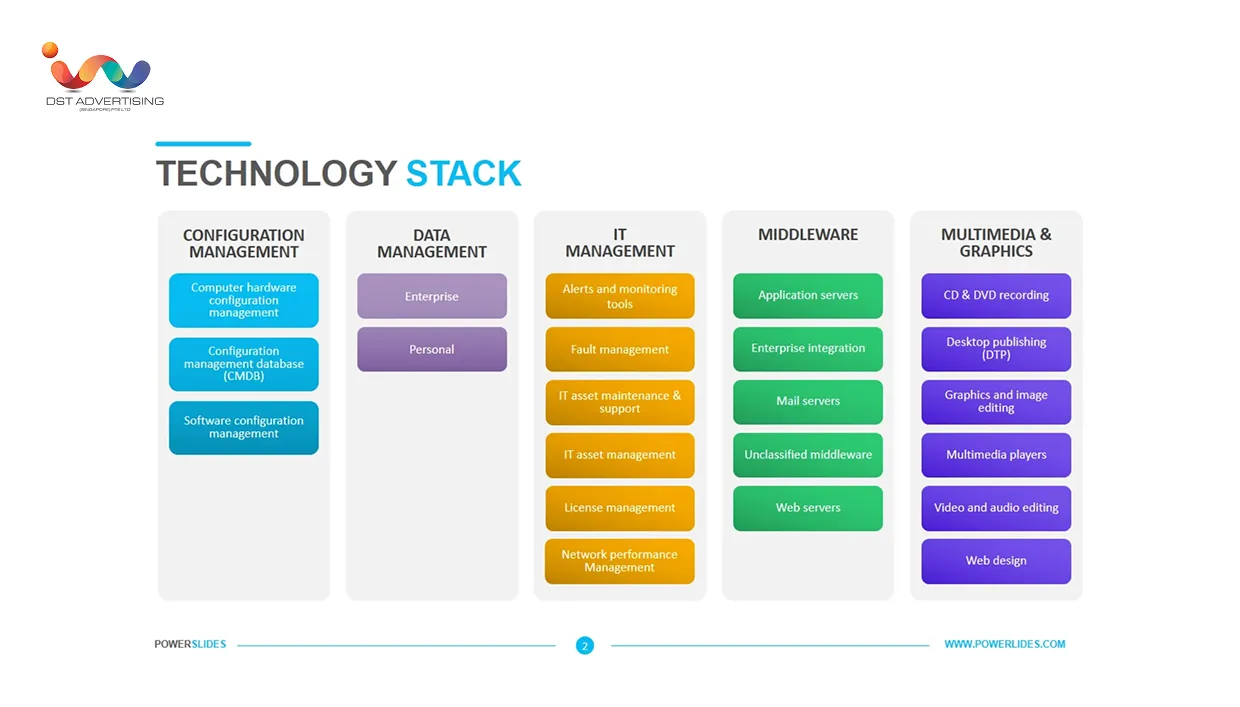
Every website, mobile application, SaaS platform, and digital service relies on a collection of technologies working together behind the scenes. These technologies determine how a product looks, how users interact with it, how information is processed, and how securely and efficiently the system operates.
This combination of programming languages, frameworks, databases, servers, APIs, development tools, and other technologies is known as a tech stack or technology stack.
A well-designed tech stack can help businesses build reliable digital services, scale their platforms, improve performance, and introduce new features more efficiently. The wrong combination of technologies, on the other hand, can create performance problems, security risks, development bottlenecks, and higher maintenance costs.
In this guide, we'll explain what a tech stack is, how it works, the main components of a technology stack, popular tech stack examples, and how businesses can choose the right stack for their digital products.
What Is a Tech Stack?
A tech stack is a collection of technologies used to build, operate, and maintain a digital product or service.
It can include:
- Programming languages
- Frontend frameworks
- Backend frameworks
- Databases
- Web servers
- APIs
- Cloud platforms
- Content management systems
- DevOps tools
- Security technologies
- Monitoring and analytics tools
For example, a web application might use React for its frontend, Node.js for its backend, PostgreSQL for its database, and AWS for cloud infrastructure.
Together, these technologies form the application’s technology stack.
The exact stack depends on what a business is building. A simple company website may need a relatively small stack, while a large e-commerce platform, banking application, healthcare system, or SaaS product can require dozens of technologies working together.
How Does a Tech Stack Work?
A tech stack works by dividing a digital service into different technical layers.
Consider an online shopping platform.
When a customer opens the website, the frontend displays products and allows the customer to interact with the page. The backend processes requests, manages business logic, and communicates with other systems. The database stores information such as products, customers, orders, and inventory.
APIs can connect the platform to external services such as payment gateways, shipping providers, email platforms, and analytics systems.
Cloud infrastructure provides the computing resources needed to run the application.
A simplified flow looks like this:
User → Frontend → API/Backend → Database → Backend → Frontend → User
Additional services can operate alongside this architecture, including:
Authentication → Payment gateway → Cloud infrastructure → Monitoring → Analytics
Each part has a specific responsibility, but they must work together as one system.
What Are the Main Components of a Tech Stack?
Although technology stacks vary considerably, most modern digital products contain several common layers.
1. Frontend Technology
The frontend is the part of a digital product that users see and interact with.
For a website or web application, frontend development commonly involves:
- HTML
- CSS
- JavaScript
- TypeScript
- React
- Angular
- Vue.js
- Next.js
The frontend is responsible for elements such as:
- Navigation
- Buttons
- Forms
- Images
- Product pages
- Dashboards
- Menus
- Animations
- Responsive layouts
For example, when a customer clicks “Add to Cart,” the frontend captures that interaction and communicates with the backend to update the customer’s shopping cart.
Frontend frameworks
Modern applications often use frameworks or libraries to make frontend development more structured and scalable.
React is widely used for building interactive user interfaces.
Angular provides a more structured framework for developing large web applications.
Vue.js is another popular JavaScript framework known for its approachable development model.
Next.js builds on React and provides features for server-side rendering, static generation, routing, and full stack web development.
The right choice depends on the product’s requirements and the development team’s expertise.
2. Backend Technology
The backend is responsible for the logic and processes that operate behind the user interface.
It can handle:
- User authentication
- Business logic
- Database operations
- Payments
- File processing
- API requests
- User permissions
- Notifications
- Data validation
Popular backend technologies include:
- Node.js
- Python
- Java
- PHP
- Ruby
- C#
- Go
Backend frameworks can include:
- Express.js
- Django
- FastAPI
- Laravel
- Spring Boot
- ASP.NET Core
- Ruby on Rails
For example, when a user logs into an application, the frontend sends login information to the backend. The backend verifies the credentials, communicates with the database, and returns the appropriate authentication response.
3. Database
A database stores and organises the information used by a digital service.
Depending on the application, databases can store:
- Customer accounts
- Product information
- Orders
- Payments
- Messages
- User preferences
- Website content
- Transaction records
Two broad database categories are commonly used.
Relational databases
Relational databases organise information into tables with structured relationships.
Popular examples include:
- PostgreSQL
- MySQL
- Microsoft SQL Server
- Oracle Database
They are commonly used when applications require structured data and relationships between different records.
NoSQL databases
NoSQL databases use different data models and can be useful for applications requiring flexible schemas or particular scalability characteristics.
Examples include:
- MongoDB
- Redis
- Cassandra
- DynamoDB
The choice between SQL and NoSQL depends on factors such as data structure, query requirements, scalability, consistency requirements, and application architecture.
4. APIs
An API, or Application Programming Interface, allows different software systems to communicate with each other.
APIs are particularly important for modern digital services because applications rarely operate completely independently.
For example, an e-commerce website might connect to:
- A payment provider
- Shipping software
- CRM software
- Email services
- Accounting systems
- Inventory platforms
- Analytics tools
The website can use APIs to send and receive information between these systems.
For example:
E-commerce website → Payment API → Payment provider
The payment provider processes the transaction and sends a response back to the website.
APIs therefore act as communication channels between different software components.
5. Cloud Infrastructure
Modern applications often run on cloud infrastructure rather than relying exclusively on physical servers.
Popular cloud providers include:
- Amazon Web Services (AWS)
- Microsoft Azure
- Google Cloud
- Oracle Cloud
Cloud infrastructure can provide computing resources, databases, storage, networking, security services, monitoring, and other capabilities.
For businesses, cloud technology can make it easier to scale resources as demand changes.
For example, an online store may experience significantly more traffic during a major sale. Cloud infrastructure can provide the resources required to handle increased demand when the system is properly designed.
6. DevOps and Development Tools
Building the application is only one part of running a digital service.
Development teams also need tools for:
- Source-code management
- Testing
- Deployment
- Continuous integration
- Continuous delivery
- Infrastructure management
- Monitoring
- Error tracking
Common tools include:
- Git
- GitHub
- GitLab
- Docker
- Kubernetes
- Jenkins
- Terraform
DevOps practices help development and operations teams automate processes and deliver software more consistently.
7. Security Technologies
Security should be considered part of the technology stack rather than something added after development.
Security-related technologies and practices can include:
- Authentication
- Authorisation
- Encryption
- Firewalls
- Identity management
- Secure APIs
- Secrets management
- Vulnerability scanning
- Security monitoring
For applications handling sensitive customer or financial information, security can become one of the most important architectural considerations.
What Is a Full-Stack Technology Stack?
The term full stack generally refers to the combination of frontend and backend technologies used to build an application.
A full-stack developer may work across:
Frontend + Backend + Database + APIs + Infrastructure
For example, a developer could use:
React + Node.js + PostgreSQL + AWS
This doesn’t mean that every full-stack developer must be an expert in every infrastructure technology. Rather, full-stack development generally involves working across multiple layers of an application.
Popular Tech Stack Examples
Different types of digital products require different technology combinations.
Here are several common examples.
MERN Stack
The MERN stack consists of:
- MongoDB – Database
- Express.js – Backend framework
- React – Frontend library
- Node.js – Runtime environment
MERN is popular for JavaScript based web applications because JavaScript or its ecosystem can be used across much of the application.
A simplified architecture is:
React → Node.js/Express → MongoDB
MEAN Stack
The MEAN stack consists of:
- MongoDB
- Express.js
- Angular
- Node.js
The main difference between MERN and MEAN is the frontend technology.
MERN uses React, while MEAN uses Angular.
LAMP Stack
LAMP is one of the classic web technology stacks.
It traditionally includes:
The LAMP stack has powered a large number of websites and web applications over the years.
It remains relevant, particularly for PHP-based applications and websites.
Python Technology Stack
A Python-based application might use:
Python + Django + PostgreSQL + Redis + AWS
Python can be used for web development, data processing, automation and AI related applications.
Django provides a mature framework for building web applications, while PostgreSQL can handle structured application data.
Java Technology Stack
An enterprise application might use:
Java + Spring Boot + PostgreSQL + Docker + Kubernetes
Java remains widely used in enterprise environments where organisations need mature development ecosystems and scalable application architectures.
.NET Stack
A Microsoft oriented application could use:
C# + ASP.NET Core + SQL Server + Azure
This combination can be suitable for businesses already operating within Microsoft’s technology ecosystem.
What Is a Tech Stack for a Website?
A website’s tech stack is the collection of technologies used to build and operate it.
A typical modern website might contain:
Frontend: HTML, CSS, JavaScript
Framework: React or Next.js
Backend: Node.js
Database: PostgreSQL
Hosting: Cloud platform
CDN: Content delivery network
Analytics: Web analytics platform
Security: HTTPS, authentication and security controls
A simpler business website may use a CMS such as WordPress instead.
This is important because not every website needs a complex technology stack.
A five page company website does not necessarily require the same architecture as a large SaaS platform.
What Is a SaaS Tech Stack?
A SaaS technology stack is the collection of technologies used to build and operate a software-as-a-service product.
A SaaS platform may need:
- Frontend application
- Backend services
- Database
- Authentication
- APIs
- Cloud infrastructure
- Billing
- Monitoring
- Security
- Analytics
For example:
Next.js + Node.js + PostgreSQL + Redis + AWS
could form part of a SaaS architecture.
However, SaaS applications often become much more complex as they grow.
They may require:
- Multi-tenant architecture
- Role-based access control
- Subscription management
- Usage tracking
- Automated billing
- Background jobs
- Caching
- Logging
- Monitoring
- Data backups
Therefore, choosing a SaaS tech stack requires considering not only the first version of the product but also its expected growth.
Why Does a Tech Stack Matter?
Choosing technologies is not simply a technical decision. It can influence the long-term cost, performance and flexibility of a digital product.
Performance
The architecture and technologies selected can influence how quickly an application processes requests and delivers content.
Scalability
A technology stack should be able to support the expected growth of users, transactions and data.
Security
Some applications require stronger authentication, encryption, access controls and monitoring than others.
Development Speed
Familiar technologies and mature frameworks can help teams build and release features more efficiently.
Maintenance
A stack that is easy to maintain can reduce long term development costs.
Hiring
Businesses should consider whether developers with relevant skills are available in their target market.
Integration
A new application may need to connect with existing ERP, CRM, payment, marketing or accounting systems.
Cost
Technology choices can influence hosting expenses, software licensing, development costs and ongoing maintenance.
How to Choose the Right Tech Stack
There is no universally “best” technology stack.
The right choice depends on the product and business requirements.
1. Define the Product Requirements
Start by identifying what the application needs to do.
Ask:
- Who will use it?
- What features are required?
- How much data will it process?
- Does it require real-time functionality?
- Does it need mobile applications?
- Does it need third-party integrations?
- What security requirements exist?
2. Consider Scalability
Think beyond the initial launch.
A stack that works for 1,000 users may not automatically be appropriate for millions of users.
Consider expected growth in:
- Users
- Traffic
- Data
- Transactions
- Geographic markets
3. Evaluate Development Expertise
If your existing development team is experienced with a particular technology, changing stacks may increase development time and costs.
Technology decisions should therefore consider the team’s actual skills.
4. Consider Security Requirements
Applications handling financial information, healthcare data or other sensitive information may require additional security controls.
Security requirements should be considered during architecture planning rather than after development.
5. Consider Integration Requirements
If the product needs to connect to existing systems, check whether APIs and supported integrations are available.
For example, an ERP system may need to connect with:
- E-commerce platforms
- CRM software
- Payment gateways
- Accounting systems
- Inventory management tools
6. Consider Total Cost of Ownership
The cheapest technology at launch is not necessarily the cheapest technology over five years.
Consider:
Development + Hosting + Maintenance + Security + Scaling + Hiring
This provides a more realistic view of the technology’s long-term cost.
How Tech Stacks Power Digital Services
A technology stack is essentially the infrastructure behind a digital experience.
Consider an online food delivery platform.
A customer opens the application and searches for a restaurant.
The frontend displays restaurants and menus.
The backend receives the search request.
The database provides restaurant and menu information.
The API communicates between different services.
The payment system processes the customer’s transaction.
The notification system sends an order update.
The cloud infrastructure provides the computing resources required to run these services.
The complete journey may look like:
Customer → Mobile/Web App → API → Backend → Database
and:
Backend → Payment API → Payment Provider
while:
Backend → Notification Service → Customer
All of these components form part of the broader technology architecture.
How Tech Stacks Support Digital Transformation
Digital transformation involves more than moving existing processes online.
Businesses increasingly use technology to redesign how they operate.
A modern technology stack can support:
- Business automation
- AI integration
- Data analytics
- Cloud migration
- Customer portals
- Mobile applications
- E-commerce
- ERP integration
- CRM integration
- Digital payments
- Remote collaboration
For example, a business might replace manual order processing with an automated workflow:
Customer Order → E-commerce Platform → ERP → Inventory → Payment → Shipping → Customer Notification
APIs and cloud services can connect these systems and reduce the need for employees to manually transfer information.
This is one reason technology architecture has become an important part of modern digital transformation.
Common Tech Stack Mistakes
Choosing technologies based purely on popularity can create problems.
Choosing Technology Because It Is Trendy
A popular framework may not be appropriate for every project.
Overengineering
Small applications can become unnecessarily complex when too many technologies are introduced.
Ignoring Maintenance
Businesses should consider who will maintain the system after launch.
Focusing Only on Development Cost
Hosting, security, upgrades and maintenance can represent significant long term costs.
Ignoring Security
Security should be incorporated into the architecture from the beginning.
Choosing Too Many Technologies
Every additional technology introduces another dependency that developers need to understand and maintain.
Not Planning for Growth
The initial architecture should account for realistic future requirements without unnecessarily building for extreme scale.
Final Thoughts
A tech stack is the technological foundation of a digital product. It determines how the frontend interacts with users, how backend services process information, how databases store data, how APIs connect systems and how cloud infrastructure keeps applications running.
There is no single technology stack that works for every business.
A corporate website, e-commerce platform, SaaS product, mobile application and enterprise ERP system can all require very different architectures.
The right technology stack should therefore be selected according to the product’s functionality, users, scalability requirements, security needs, integrations, development expertise and long-term costs.
As businesses continue investing in AI, cloud computing, automation and digital transformation, understanding technology stacks is becoming increasingly important. A carefully planned architecture can provide the foundation businesses need to build reliable digital services, connect their systems and scale their operations.
Whether a business is developing a new website, mobile application, SaaS platform or enterprise solution, the technology stack should support the business objective not simply follow the latest technology trend.