How to Register a Business in Singapore: A Step-by-Step Guide Using GoBusiness and Bizfile
Starting a business in Singapore involves more than choosing a business idea and opening a bank account. Before you begin operating, you may need to register your business with the Accounting and Corporate Regulatory Authority (ACRA) and obtain any licences or approvals required for your activities.
For entrepreneurs researching how to register a business in Singapore, the GoBusiness Portal is a useful starting point for government business services, licences and regulatory information. However, the actual registration of a business entity is completed through ACRA's Bizfile portal.
This guide explains the Singapore business registration process, including how to choose a business structure, reserve a business name, register through Bizfile, understand the costs, and identify the steps required after registration.
Do You Need to Register a Business in Singapore?
Generally, you need to register a business if you regularly carry out activities for profit, unless a specific exemption applies.
This includes many types of businesses, such as:
- Retail businesses
- Online stores
- E-commerce businesses
- Home-based businesses
- Dropshipping businesses
- Freelance businesses operating under a business name
- Professional services
- Social-media businesses
ACRA states that businesses generally need registration when they regularly carry out activities for profit or use a name other than the owner’s full NRIC name. You must also be at least 18 years old to register a business.
For example, someone operating under their exact full NRIC name may fall under an exemption, while using a separate brand name generally requires registration.
Operating a business that should be registered without doing so can result in penalties. ACRA states that non-compliance can carry a fine of up to $10,000 or imprisonment for up to two years.
What Is the GoBusiness Portal?
GoBusiness is Singapore’s government business-services platform designed to make it easier for businesses to access government services and information.
Entrepreneurs can use government digital services to explore areas such as:
- Business licences
- Regulatory requirements
- Government services
- Business resources
- Industry-specific requirements
However, it is important to understand the distinction between GoBusiness and Bizfile.
GoBusiness vs Bizfile
GoBusiness:
Useful for discovering government business services, licences and requirements.
ACRA Bizfile:
The official ACRA portal used to register business entities, manage registered entities, file documents and access business information.
Therefore, if your goal is specifically to register a company, sole proprietorship or partnership, you will ultimately use ACRA’s Bizfile system.
Step 1: Choose Your Business Structure
Before registering, decide what type of business entity you want to establish.
Common structures include:
- Sole proprietorship
- Partnership
- Limited Liability Partnership (LLP)
- Private company limited by shares
The structure you choose can affect liability, administration, costs, taxation, ownership and future growth.
Sole Proprietorship
A sole proprietorship is owned by one individual.
It can be relatively straightforward to establish and is often considered by individuals starting smaller businesses.
However, the owner does not have the same separation between personal and business liability that exists with a company.
Partnership
A partnership is owned by two or more partners.
Partners share responsibility for the business according to the partnership arrangement and applicable laws.
Limited Liability Partnership
An LLP combines features of a partnership with limited liability protection.
It can be useful for certain professional and service-based businesses.
Private Company Limited by Shares
A private limited company is a separate legal entity from its shareholders.
This structure is commonly considered by businesses planning to grow, raise investment, employ staff, or build a more formal corporate structure.
The appropriate structure depends on your circumstances, so businesses should consider liability, ownership, tax and compliance requirements before registering.
Step 2: Choose Your Business Name
Once you have decided on a structure, you need to choose a business or company name.
The name must be submitted for approval before you register the entity.
ACRA’s current process requires businesses to reserve the proposed name before proceeding with registration.
When choosing a name, consider:
- Whether it accurately represents your business
- Whether it may conflict with an existing entity
- Whether it could infringe another party’s intellectual property
- Whether it is appropriate for your industry
- Whether you intend to use the same name for your website and brand
It is also useful to check your preferred domain name and social media handles before committing to a brand identity.
How Much Does It Cost to Register a Business in Singapore?
The cost depends on the type of business structure.
For example, ACRA currently lists the following fees:
Private Company
- Business name application: S$15
- Company registration: S$300
This makes the basic ACRA setup fees S$315, excluding other professional or service costs that may apply.
Sole Proprietorship or Partnership
ACRA currently lists:
- S$100 for one year, or
- S$160 for three years, subject to the applicable conditions for the three-year option.
The business name application fee is separate.
These government fees can change, so check the latest ACRA fee schedule before submitting an application.
Step 3: Reserve Your Business Name
After deciding on your preferred name, submit the name application through Bizfile.
You will need to select the appropriate entity type because the entity type chosen during name reservation needs to match the entity you subsequently register.
If the name is approved, you can proceed with the business registration process.
It is important to remember that name approval does not mean the business has been registered.
You still need to complete the entity registration.
Step 4: Prepare Your Business Information
Before starting the registration application, prepare the required information.
Depending on your business structure, this may include:
- Approved business name
- Business activity
- Proposed commencement date
- Business email
- Business address
- Owner information
- Partner information
- Director information
- Shareholder information
- Residential addresses
- Contact details
- Registered office information
- Financial year end
- Share capital information
- Company constitution
The exact requirements depend on the business structure.
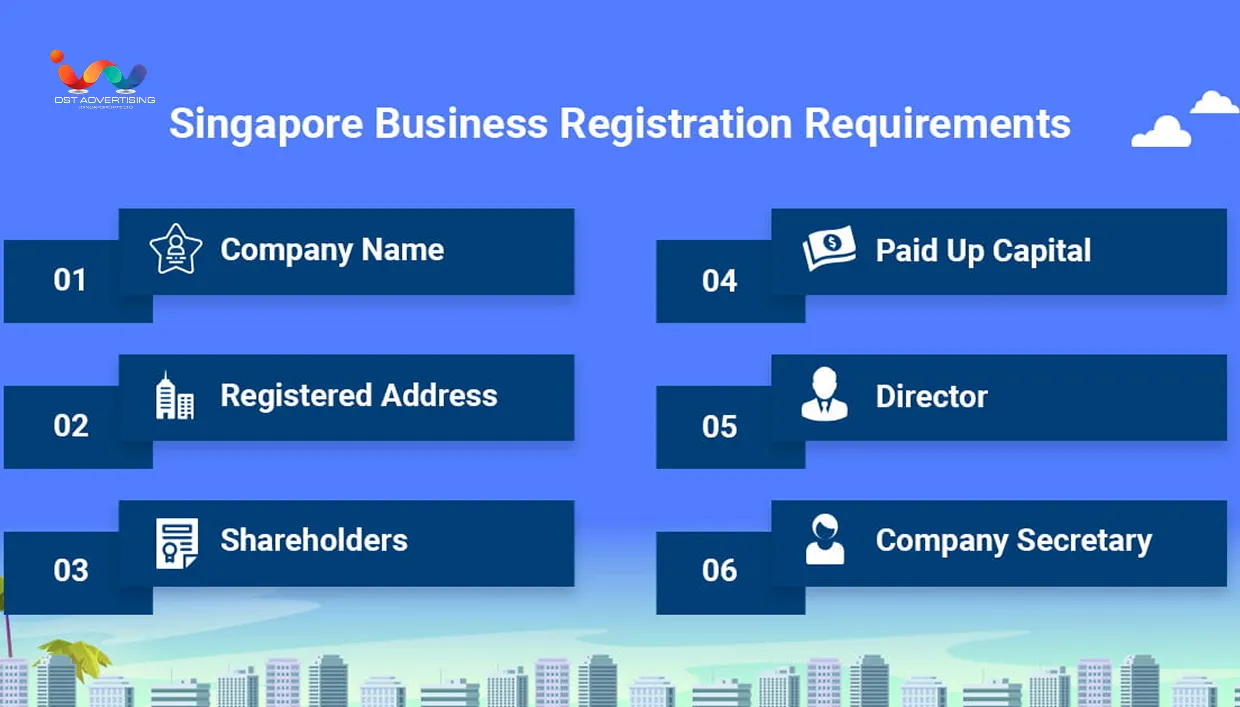
For example, registering a company involves information about directors, shareholders, share capital, company constitution and the registered office.
Step 5: Log in to Bizfile
Once your business name has been approved, go to the ACRA Bizfile portal.
ACRA’s current process is:
Login → Register → Register new entity → Register new business entity
You then retrieve the approved name information and continue with the registration application.
Individuals generally use Singpass, while Corporate Service Providers (CSPs) use Corppass where applicable.
Step 6: Enter Your Business Details
The registration application requires information about the business.
For a sole proprietorship or partnership, this can include:
- Proposed commencement date
- Business email
- Business address
- Owner or partner details
- Contact information
For a company, additional information can include:
- Financial year end
- Registered office address
- Company email
- Office hours
- Directors
- Shareholders
- Share capital
- Company constitution
A Singapore company must have a registered office address in Singapore. ACRA also specifies requirements concerning accessibility of the registered office.
Step 7: Add Owners, Directors and Shareholders
The people associated with the entity must be added during registration.
For a sole proprietorship, you need to provide the owner’s details.
For a partnership, the partners need to be included.
For a company, you may need to provide information about:
- Directors
- Shareholders
- Company secretary where applicable
- Nominee directors or shareholders where applicable
- Registrable controllers
- Other relevant position holders
ACRA’s Bizfile process also requires companies to provide information relating to registrable controllers and nominee arrangements where applicable.
Step 8: Submit the Company Constitution
When registering a Singapore company, you need to deal with the company’s constitution.
ACRA allows applicants to either:
- Use the model constitution, or
- Upload a customised constitution.
The constitution establishes rules relating to how the company operates.
For straightforward businesses, the model constitution may be appropriate, while businesses with more complex ownership or governance requirements may need professional advice.
Step 9: Pay the Registration Fee
After reviewing the information, you can submit the registration application and make the required payment.
For a Singapore private company, ACRA’s current registration fee is S$300, in addition to the S$15 business-name application fee.
Most registrations are approved soon after payment.
However, ACRA states that complex applications can take up to 15 working days, while applications requiring referral-authority approval can take 14 to 60 days.
Step 10: Receive Your UEN
Once your registration is approved, ACRA provides a Unique Entity Number (UEN).
The UEN is an important identifier used when dealing with Singapore government agencies.
Depending on the entity type, you can also receive a Business Profile or company information through Bizfile.
Your UEN may be required for activities such as:
- Government transactions
- Business licences
- Tax-related matters
- Banking
- Corporate filings
- Other official business transactions
What Should You Do After Registering Your Business?
Business registration is only the beginning.
After registration, you may need to complete additional tasks depending on your business activities.
1. Open a Business Bank Account
A dedicated business bank account can help separate business transactions from personal finances.
Banks may request documents such as:
- UEN
- Business Profile
- Identification documents
- Company constitution
- Information about directors or owners
Requirements vary by bank.
2. Check Business Licence Requirements
Not every business requires the same licences.
Your requirements may depend on your industry and activities.
For example, businesses operating in sectors such as food, education, finance, healthcare or certain regulated industries may require additional approvals or licences.
This is where the GoBusiness ecosystem can be particularly useful for identifying relevant government services and licensing requirements.
3. Understand GST Registration
GST registration may become relevant as your business grows or depending on your taxable turnover and circumstances.
Do not assume that business registration with ACRA automatically means GST registration.
GST is administered separately by the Inland Revenue Authority of Singapore (IRAS).
4. Set Up Accounting and Bookkeeping
Establish proper accounting processes from the beginning.
Depending on your business, this may include:
- Invoicing
- Expense tracking
- Payroll
- Bank reconciliation
- Financial reporting
- Tax records
- Digital payments
Using cloud accounting software can make financial administration easier as the business grows.
5. Consider InvoiceNow
Singapore businesses should also consider their e-invoicing requirements.
InvoiceNow is Singapore’s nationwide e-invoicing network based on the Peppol standard. IRAS is progressively implementing the GST InvoiceNow Requirement for GST-registered businesses.
Therefore, businesses choosing accounting or ERP software should consider whether their systems can support relevant InvoiceNow requirements.
6. Build Your Digital Presence
After registering the business, establish your online presence.
This may include:
- Business website
- Google Business Profile
- Social media profiles
- Professional email
- Online payment options
- E-commerce platform
- CRM system
- Digital marketing strategy
A registered business with a strong digital presence can make it easier for customers to discover and contact the company.
Can Foreigners Register a Business in Singapore?
Yes, foreigners can establish businesses in Singapore, but additional requirements apply.
ACRA states that foreigners must engage a Corporate Service Provider (CSP) to reserve a business name and register a business structure. Foreigners also need to meet applicable local residency requirements.
If a foreign entrepreneur wants to relocate to Singapore and operate the business there, the appropriate work-pass requirements also need to be considered.
The exact requirements depend on the individual’s immigration status and business structure.
Common Mistakes When Registering a Business in Singapore
Choosing the Wrong Business Structure
Do not select a structure based solely on the cheapest registration fee.
Consider liability, ownership, taxation, compliance and future growth.
Registering a Name Without Checking the Brand
Before committing to a business name, consider domain availability, trademarks and social media branding.
Ignoring Licensing Requirements
ACRA registration does not automatically give you permission to perform every type of business activity.
Check whether your industry requires additional licences or approvals.
Mixing Personal and Business Finances
Set up appropriate accounting and banking processes early.
Treating Registration as the End of the Process
Registration creates the business entity, but ongoing tax, accounting, licensing, employment and corporate compliance requirements may still apply.
Singapore Business Registration Checklist
Before submitting your application, make sure you have:
- Chosen your business structure
- Selected a business name
- Applied for name approval
- Prepared your business address
- Prepared owner/director/shareholder information
- Prepared your business email
- Determined your business activities
- Prepared company constitution information if required
- Checked licensing requirements
- Prepared the registration fee
- Submitted the application through Bizfile
- Received your UEN
- Checked post-registration requirements
- Set up accounting and banking
- Established your digital presence
Final Thoughts
Registering a business in Singapore is a structured digital process, but entrepreneurs should understand the difference between GoBusiness and ACRA Bizfile.
GoBusiness is useful for accessing government business services, information and licensing resources, while Bizfile is ACRA’s official portal for business registration and corporate filings.
The basic process is:
Choose a business structure → Reserve your business name → Prepare your information → Register through Bizfile → Pay the applicable fee → Receive your UEN → Complete post-registration requirements.
For businesses planning to grow, registration should also be viewed as the beginning of a broader business setup process. Accounting, taxation, licences, banking, cybersecurity, digital infrastructure and online marketing can all become important as the company develops.
Always check the latest requirements directly with ACRA, IRAS and the relevant Singapore government agencies before submitting your application, because fees, regulations and eligibility requirements can change.