AI Sales Agents: How Businesses Can Generate and Qualify Leads 24/7
Generating leads is one of the biggest priorities for businesses that want to grow. However, traditional sales teams cannot respond to every potential customer immediately. Prospects may visit a website outside business hours, ask questions while sales representatives are unavailable, or leave before anyone has an opportunity to follow up.
AI sales agents are changing this process by allowing businesses to engage prospects, answer questions, capture information, and qualify leads 24/7.
Unlike basic chatbots that primarily answer frequently asked questions, AI sales agents can be designed to participate in sales conversations, understand customer intent, recommend relevant solutions, and move qualified prospects toward the next stage of the sales funnel.
For businesses in competitive markets such as Singapore, this can create an opportunity to improve lead response times while allowing human sales teams to focus on high-value conversations.
What Is an AI Sales Agent?
An AI sales agent is an artificial intelligence-powered system designed to support or automate parts of the sales process.
It can communicate with potential customers through channels such as:
- Business websites
- WhatsApp
- Live chat
- Social messaging platforms
- Email
- Other digital customer-service channels
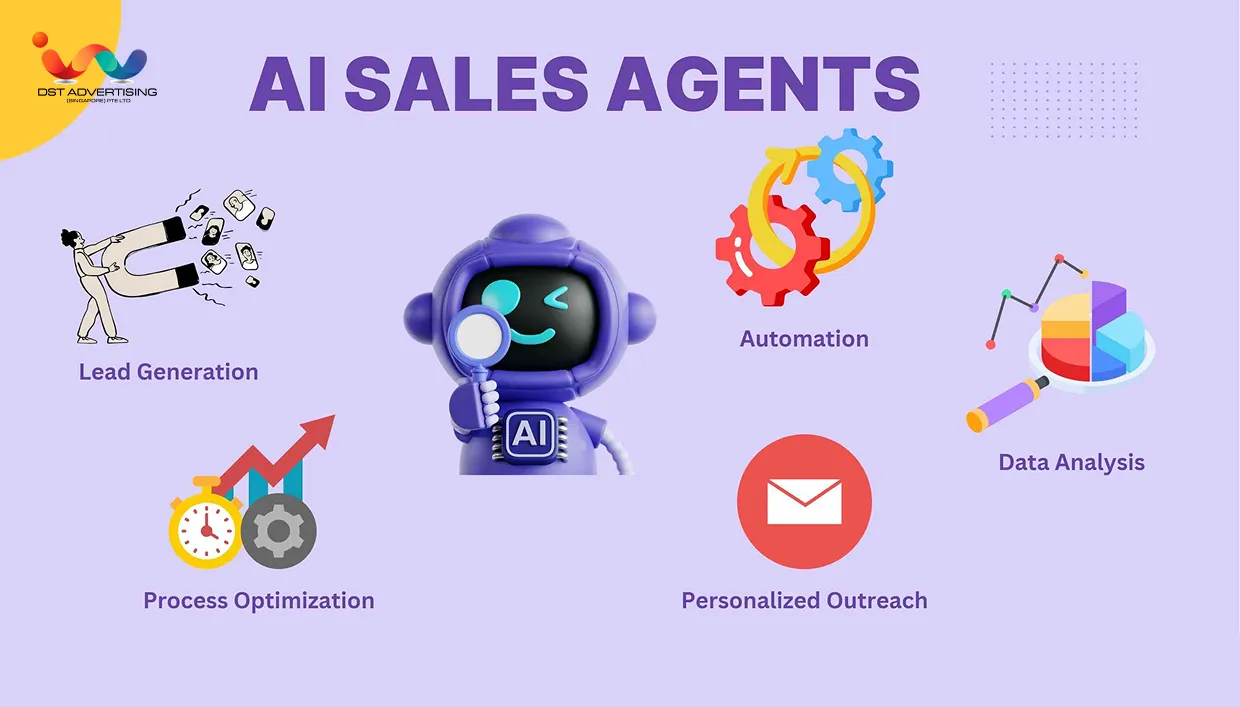
Depending on its configuration, an AI sales agent can:
- Engage website visitors
- Answer product and service questions
- Identify customer needs
- Qualify leads
- Collect contact information
- Recommend products or services
- Handle common sales objections
- Schedule appointments
- Update CRM records
- Transfer qualified prospects to human sales representatives
The goal is not necessarily to replace a sales team. Instead, AI can handle repetitive and time-sensitive tasks so sales professionals can concentrate on conversations that require human judgment.
AI Sales Agent vs Traditional Chatbot
Although the terms are sometimes used interchangeably, AI sales agents and traditional chatbots can serve different purposes.
Feature | Traditional Chatbot | AI Sales Agent |
FAQ answers | Yes | Yes |
Natural conversations | Limited to advanced systems | Yes |
Lead qualification | Basic | Advanced |
Product recommendations | Limited | Yes |
Sales conversations | Limited | Yes |
Appointment scheduling | Sometimes | Yes |
Lead follow-up | Limited | Can be automated |
CRM integration | Sometimes | Common |
Human handoff | Yes | Yes |
24/7 availability | Yes | Yes |
A traditional chatbot may answer a question such as “What are your opening hours?”
An AI sales agent can take the conversation further:
Customer: “I’m looking for SEO services for my business.”
AI Sales Agent: “Absolutely. What type of business do you operate, and are you mainly interested in increasing local visibility, organic traffic, or online sales?”
This makes the interaction more closely connected to the sales process.
How AI Sales Agents Generate Leads 24/7
1. Engage Website Visitors
Many website visitors leave without contacting a business.
An AI sales agent can proactively offer assistance when visitors show interest in a product or service.
For example:
“Looking for the right digital marketing package? Tell me about your business and I’ll help you find the most suitable option.”
This creates an opportunity to turn passive visitors into active conversations.
2. Capture Contact Information
Once a visitor demonstrates interest, the AI sales agent can request relevant information.
This could include:
- Name
- Email
- Phone number
- Company
- Industry
- Service required
- Budget
- Project timeline
The agent can collect this information conversationally instead of relying only on a traditional contact form.
3. Respond Outside Business Hours
One of the biggest benefits of AI sales agents is their availability.
A prospect might discover your business at midnight and have an important question. If nobody responds until the next morning, the prospect may move on.
An AI sales agent can immediately answer questions and capture the lead.
This allows businesses to create a 24/7 lead-generation system rather than limiting sales opportunities to working hours.
4. Convert Existing Website Traffic
Businesses often spend money on SEO, Google Ads, social media, and content marketing to attract visitors.
But traffic alone does not generate revenue.
AI sales agents can help businesses make better use of existing traffic by:
- Answering questions
- Addressing objections
- Recommending services
- Qualifying prospects
- Collecting contact details
- Encouraging consultations
This can potentially improve the conversion rate without requiring the same increase in advertising spend or website traffic.
How AI Sales Agents Qualify Leads
Lead generation is only the first step.
Sales teams also need to determine which prospects are most likely to become customers.
AI sales agents can automate this initial qualification process.
Ask Qualification Questions
For example, a B2B software company could ask:
- What type of business do you operate?
- How many employees do you have?
- What solution are you currently using?
- What problem are you trying to solve?
- What is your expected implementation timeline?
- What is your approximate budget?
The AI can analyse the answers and determine whether the prospect meets predefined qualification criteria.
Identify High-Intent Prospects
Not every lead has the same level of buying intent.
A visitor asking:
“What does your service do?”
may still be researching.
A visitor asking:
“Can I schedule a demo tomorrow?”
is likely much closer to making a purchasing decision.
AI sales agents can identify signals such as:
- Specific product interest
- Pricing questions
- Purchase timelines
- Budget information
- Appointment requests
- Product comparisons
- Requests for demonstrations
This information can help sales teams prioritise their efforts.
AI Lead Scoring
AI sales agents can also support automated lead scoring.
A business could assign different values to different actions.
For example:
Customer Action | Potential Intent |
Reads a blog post | Low |
Views pricing | Medium |
Asks about features | Medium |
Requests a quote | High |
Books a consultation | Very high |
Requests a demo | Very high |
These signals can be combined with information provided during the conversation.
A highly qualified lead can then be sent directly to a salesperson.
AI Sales Agents Can Handle Common Sales Questions
Customers often have questions before they are ready to buy.
For example:
- How much does it cost?
- What is included?
- How long does implementation take?
- Do you offer custom packages?
- Is there a contract?
- Do you provide support?
- How is your service different from competitors?
AI sales agents can answer many of these questions using an approved business knowledge base.
This allows potential customers to get the information they need without waiting for a salesperson.
AI Sales Agents Can Handle Basic Objections
Sales conversations often involve objections.
A prospect may say:
“Your service is too expensive.”
A properly configured AI sales agent can respond with relevant information about value, features, packages, or alternatives without making unsupported claims.
For example:
“Our pricing reflects the level of support and customisation included. If you’re working with a smaller budget, I can show you our entry-level option.”
The objective is not to pressure the customer. It is to provide useful information that helps them make an informed decision.
Complex negotiations should still be handled by a human sales professional.
AI Sales Agents Can Book Meetings
Once a prospect is qualified, the next step is often a sales call or consultation.
An AI sales agent can help automate scheduling.
For example:
AI: “Based on your requirements, a consultation with our team would be useful. Would you like to schedule one?”
The system can then guide the prospect through the available scheduling process.
This eliminates unnecessary back-and-forth communication and allows sales teams to receive meetings that are already qualified.
AI Sales Agents and CRM Integration
Connecting an AI sales agent to a CRM can make the system significantly more useful.
Instead of simply collecting a lead’s contact information, the system can potentially send information such as:
- Customer name
- Contact details
- Company
- Requirements
- Budget
- Conversation summary
- Lead score
- Product interest
- Next action
A salesperson can then review the information before contacting the prospect.
This creates a smoother transition from automated conversation to human sales.
AI Sales Agent Example
Consider a Singapore-based web development company.
A visitor enters the website and starts a conversation.
Visitor: “How much does an e-commerce website cost?”
AI Sales Agent: “Our e-commerce projects vary depending on features and integrations. Are you looking for a Shopify store, WooCommerce website, or a custom e-commerce platform?”
Visitor: “Shopify.”
AI Sales Agent: “Great. Approximately how many products will you have, and do you require payment and shipping integrations?”
The AI continues gathering relevant information.
At the end:
AI Sales Agent: “Based on your requirements, our team can provide a more accurate estimate. Would you like to schedule a consultation?”
The business has now generated and partially qualified a lead without requiring a salesperson to participate in the initial conversation.
Benefits of AI Sales Agents for Businesses
24/7 Lead Generation
Potential customers can interact with the business at any time.
Faster Lead Response
AI can respond immediately instead of waiting for a salesperson.
Lower Manual Workload
Sales representatives spend less time answering repetitive questions.
Better Lead Qualification
Businesses can collect more information before passing prospects to sales teams.
Improved Customer Experience
Customers receive immediate assistance and clear next steps.
Scalable Sales Operations
An AI sales agent can potentially handle multiple conversations simultaneously.
More Productive Sales Teams
Salespeople can focus on qualified prospects instead of manually screening every enquiry.
AI Sales Agents for Singapore Businesses
AI sales agents can be particularly useful for Singapore SMEs because many businesses operate with relatively lean teams.
Common applications include:
Digital Marketing Agencies
AI can qualify prospects based on:
- Business type
- Current website
- Marketing goals
- Target audience
- Budget
- Required services
Real Estate
AI can ask potential buyers about:
- Property type
- Budget
- Preferred location
- Investment objectives
- Timeline
Qualified prospects can then be passed to property agents.
E-Commerce
AI can recommend products, answer questions about shipping and returns, and help customers decide what to purchase.
Education and Training
AI can answer questions about courses, fees, schedules, eligibility, and enrolment.
Professional Services
Consultancies and other professional service firms can use AI to capture enquiries, understand customer requirements, and schedule consultations.
AI Sales Agents and WhatsApp
WhatsApp can be an effective channel for AI-powered sales conversations.
A prospect could message a business and receive immediate assistance.
For example:
Customer: “I’m interested in your SEO service.”
AI: “I’d be happy to help. What type of business do you operate?”
The AI can continue the conversation, qualify the lead, and potentially schedule an appointment.
For Singapore businesses that already use WhatsApp for customer communication, adding AI automation can turn an existing communication channel into a more structured lead-generation system.
AI Sales Agents and Human Sales Teams
AI sales agents should not be viewed as a complete replacement for human sales professionals.
Humans remain important for:
- Complex negotiations
- High-value sales
- Sensitive customer situations
- Relationship management
- Custom proposals
- Complex technical discussions
- Strategic decision-making
A strong sales workflow can therefore look like:
Website / WhatsApp → AI Sales Agent → Lead Qualification → Lead Scoring → CRM → Human Sales Representative → Conversion
This approach allows AI and humans to focus on different parts of the sales process.
How to Implement an AI Sales Agent
Step 1: Define the Sales Goal
Determine what you want the AI agent to achieve.
Examples include:
- Generate more leads
- Qualify enquiries
- Book more meetings
- Increase demo requests
- Recommend products
- Reduce sales response time
Step 2: Identify Your Ideal Customer
Define the characteristics of a qualified lead.
Consider:
- Industry
- Location
- Budget
- Company size
- Requirements
- Purchase timeline
Step 3: Build a Reliable Knowledge Base
Give the AI access to accurate information about:
- Products
- Services
- Pricing
- Features
- Policies
- FAQs
- Sales processes
Step 4: Design Qualification Questions
Create a short sequence of questions that helps determine whether a prospect is a good fit.
Avoid asking unnecessary questions that make the conversation feel like a lengthy form.
Step 5: Integrate Your CRM and Scheduling Tools
Where appropriate, connect the AI agent with your CRM, calendar, and other business systems.
Step 6: Define Human Handoff Rules
Set clear conditions for transferring conversations to employees.
Step 7: Monitor Performance
Review conversations and track conversion data.
Use this information to improve the AI agent continuously.
Metrics to Measure AI Sales Agent Performance
Businesses should measure whether the AI agent is contributing to real sales results.
Important metrics include:
- Number of conversations
- Leads generated
- Lead capture rate
- Qualified lead rate
- Appointment booking rate
- Sales conversion rate
- Average response time
- Cost per qualified lead
- Revenue generated
- Human handoff rate
The ultimate goal should be measurable business growth rather than simply having an AI agent on the website.
Best Practices for AI Sales Agents
Keep the Conversation Natural
Customers should feel like they are having a useful conversation rather than completing an automated questionnaire.
Give Accurate Information
Incorrect product, pricing, or policy information can damage customer trust.
Do Not Over-Automate
Some conversations require human expertise.
Be Transparent
Customers should understand when they are interacting with an AI system, particularly when the distinction is relevant to the interaction.
Make Human Handoff Easy
A customer should never feel trapped inside an automated system.
Continuously Improve
Use real conversations and conversion data to identify weaknesses and improve the system.
The Future of AI-Powered Sales
AI sales agents are becoming more sophisticated as businesses connect artificial intelligence with CRM platforms, communication channels, scheduling systems, product databases, and marketing automation.
The future is likely to involve AI handling more of the repetitive parts of the sales funnel while human professionals focus on strategy, relationships, negotiations, and high-value opportunities.
For businesses, the biggest advantage may not be simply reducing labour costs. It may be the ability to respond to every potential customer quickly and consistently, regardless of the time of day.
Conclusion
AI sales agents can help businesses generate and qualify leads 24/7 by engaging website visitors, answering questions, collecting information, identifying buying intent, scoring prospects, and scheduling sales conversations.
For Singapore SMEs and other growing businesses, this can create a scalable sales process without requiring employees to manually manage every initial enquiry.
The most effective approach is to combine AI automation with human expertise.
AI can handle the repetitive and time-sensitive parts of lead generation, while human sales teams focus on complex conversations and closing high-value opportunities.