AI Chatbot vs Human Customer Service: Which Is Better for Singapore SMEs?
Customer expectations are changing rapidly. People want businesses to respond quickly, provide accurate information, and be available when they need assistance. For Singapore SMEs, meeting these expectations while controlling operational costs can be challenging.
This has led many businesses to consider AI chatbots for customer service. But does an AI chatbot provide a better experience than a human customer service representative?
The answer is not simply one or the other.
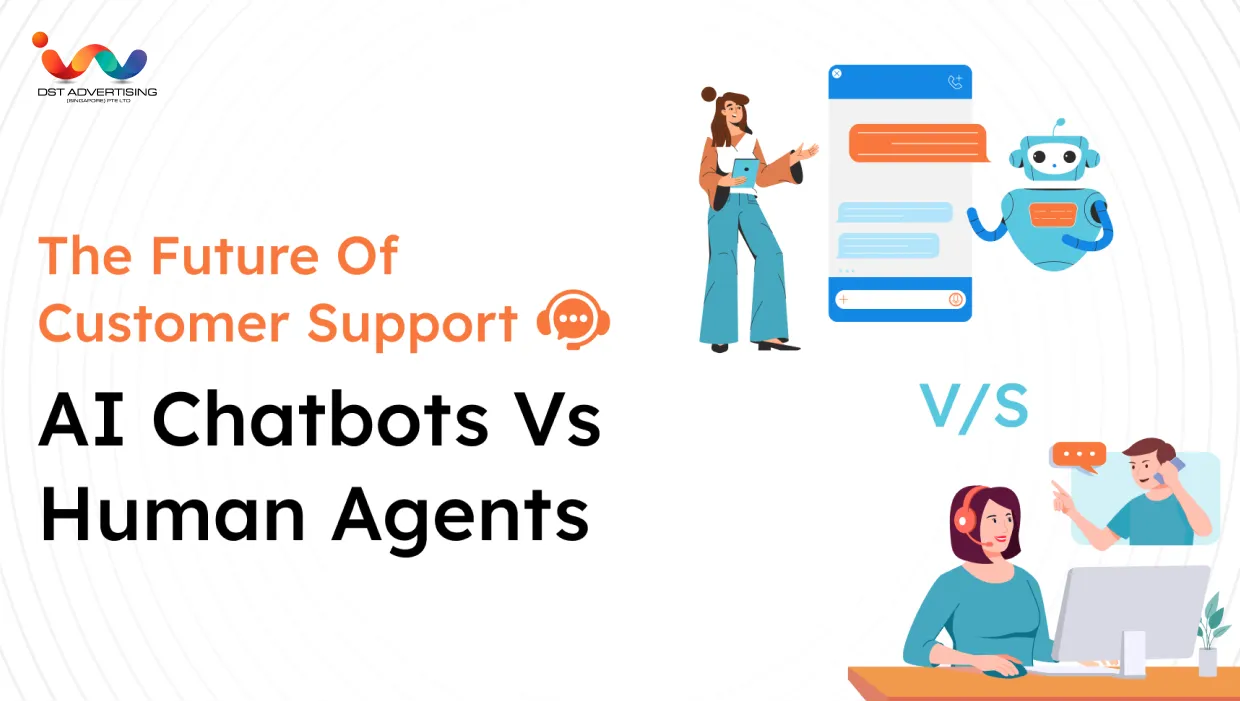
For most Singapore SMEs, the most effective approach is to combine AI chatbots with human customer service. AI can handle repetitive and straightforward enquiries, while employees can focus on complex issues, relationship building, and situations that require empathy or judgment.
Singapore's AI adoption is growing quickly. According to IMDA, AI adoption among SMEs increased from 4.2% in 2023 to 14.5% in 2024. Customer service is also one of the most common business functions where AI is being used.
What Is an AI Chatbot for Customer Service?
An AI chatbot is software that uses artificial intelligence to communicate with customers through a website, messaging platform, or other digital channel.
Modern AI chatbots can understand natural-language questions rather than relying exclusively on predefined buttons and responses.
For example, a customer might ask:
“Do you deliver to Jurong and how long does delivery usually take?”
Instead of requiring an employee to manually answer, an AI chatbot can provide information based on the company’s approved knowledge sources.
Chatbots can also help with:
- Frequently asked questions
- Product and service information
- Appointment enquiries
- Lead collection
- Order and delivery information
- Basic troubleshooting
- Business hours
- Booking requests
- Customer qualification
What Does Human Customer Service Offer?
Human customer service involves employees directly communicating with customers through phone, email, live chat, social media, or in-person channels.
Humans have an important advantage: they can understand emotional context, exercise judgment, handle unusual situations, and build relationships.
For example, a customer dealing with a serious complaint may not want to communicate with an automated system. They may expect an employee to listen, understand the problem, apologise appropriately, and find a solution.
Human support is particularly valuable when the situation involves:
- Complex complaints
- Sensitive information
- Difficult technical problems
- Negotiations
- Refund disputes
- High-value customers
- Unusual requests
- Emotional situations
AI Chatbot vs Human Customer Service
Feature | AI Chatbot | Human Customer Service |
Availability | 24/7 | Usually business hours |
Response speed | Immediate | Depends on staff availability |
Repetitive enquiries | Excellent | Time-consuming |
Complex problems | Limited | Excellent |
Emotional support | Limited | Strong |
Scalability | Very high | Requires additional staff |
Personal relationships | Limited | Excellent |
Consistency | High when properly configured | Can vary |
Lead qualification | Can be automated | Manual or assisted |
Human judgment | Limited | Excellent |
Neither option is better in every situation. The right choice depends on the type of customer interaction and the needs of the business.
Advantages of AI Chatbots for Singapore SMEs
1. 24/7 Customer Support
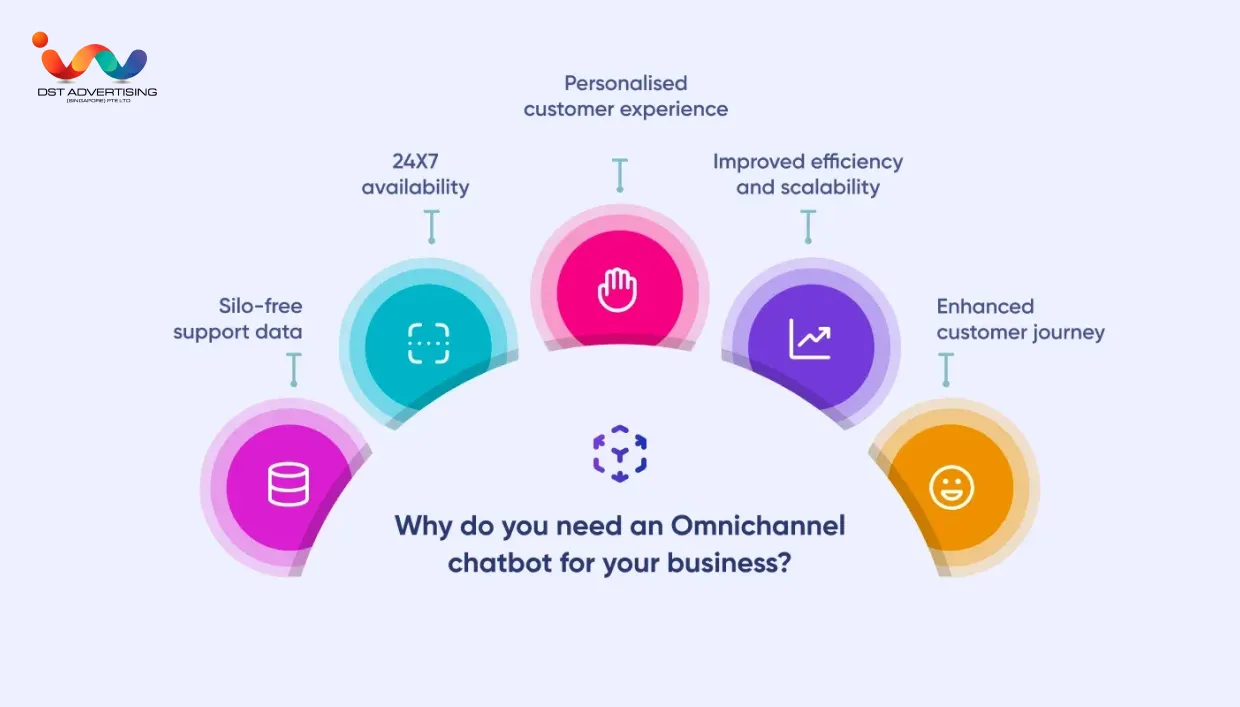
An AI chatbot can provide assistance outside normal business hours.
A customer visiting a website at midnight does not necessarily want to wait until the next morning to get an answer.
A chatbot can immediately answer common questions and capture the customer’s information for follow-up.
This is especially useful for businesses serving customers across different time zones or receiving enquiries outside traditional working hours.
2. Faster Response Times
Customers generally appreciate fast responses.
AI chatbots can respond almost immediately to questions they are equipped to handle.
A real-world Singapore example shows the potential impact. IMDA reported that Yong Kang TCM Clinic’s GenAI chatbot increased chat traffic by 60%, provided 24/7 availability, reduced response times to under five minutes, and contributed to a 20% increase in bookings.
3. Handle Repetitive Questions
Customer service teams can spend a large amount of time answering the same questions repeatedly.
Examples include:
- “What are your opening hours?”
- “Where are you located?”
- “How much does this service cost?”
- “What is your return policy?”
- “How long does delivery take?”
- “How can I book an appointment?”
An AI chatbot can automate many of these interactions, freeing employees to focus on more valuable work.
4. Handle Multiple Conversations
A human employee can only manage a limited number of conversations at once.
An AI chatbot can potentially interact with many website visitors simultaneously.
This makes AI particularly useful during periods of high demand, when customer service teams may otherwise become overwhelmed.
5. Reduce Operational Workload
Automating routine enquiries can reduce the amount of manual customer support work.
For example, IMDA reported that Singapore-based SME Milkforbubs estimated its GenAI chatbot reduced staff time spent answering customer queries by 30%. The business also reported a 60% improvement in response time.
These types of efficiency improvements can be valuable for SMEs operating with relatively small teams.
Advantages of Human Customer Service
1. Empathy and Emotional Understanding
Human employees can recognise frustration, disappointment, urgency, and other emotional signals.
If a customer has experienced a serious problem, a human representative can acknowledge the situation and respond with empathy.
This is difficult for an AI system to replicate authentically.
2. Complex Problem Solving
Some customer problems cannot be solved using a standard knowledge base.
For example, a customer may have a complicated billing issue involving several previous transactions.
A human employee can investigate the situation, consider different factors, and determine an appropriate solution.
3. Better Relationship Building
Human interaction remains important for businesses that rely heavily on trust and long-term relationships.
For example, professional services, financial services, B2B businesses, and high-value sales often benefit from direct human communication.
4. Better Handling of Sensitive Situations
Customers may feel more comfortable speaking to a person when discussing sensitive or complicated matters.
Businesses should therefore provide an easy way for customers to move from an AI chatbot to a human representative.
Which Is More Cost-Effective?
For SMEs, cost is an important consideration.
Hiring additional customer service employees can involve:
- Salaries
- Training
- Benefits
- Recruitment
- Management
- Office or equipment costs
AI chatbots can automate a portion of customer interactions without increasing staffing requirements at the same rate as customer volume.
However, an AI chatbot is not completely free to operate. Businesses may have expenses related to:
- AI platform subscriptions
- Development
- Integration
- Maintenance
- Knowledge-base updates
- Security
- Monitoring
Therefore, SMEs should evaluate the chatbot based on return on investment, rather than assuming AI is automatically cheaper.
IMDA reported that SMEs using AI-enabled solutions under the Productivity Solutions Grant achieved average cost savings of 52% in 2024.
Why Singapore SMEs Should Consider a Hybrid Model
Instead of asking whether AI or humans are better, businesses should ask:
Which customer interactions should AI handle, and which should humans handle?
A hybrid customer service model allows both technologies to do what they are best at.
AI Can Handle:
- FAQs
- Basic product information
- Business hours
- Appointment enquiries
- Order status questions
- Initial lead qualification
- Simple troubleshooting
- Customer information collection
Humans Can Handle:
- Complaints
- Complex technical issues
- Refund disputes
- Sensitive enquiries
- High-value customers
- Negotiations
- Escalations
- Relationship management
This approach can improve efficiency without sacrificing the human element of customer service.
How Human Handoff Should Work
A common mistake is making it difficult for customers to reach a human.
A well-designed AI chatbot should recognise situations where human intervention is appropriate.
For example:
Customer: “I have been charged twice for the same order.”
Chatbot: “I’m sorry you’re experiencing this. This requires our support team’s assistance. I can transfer your conversation to a customer service representative.”
The chatbot should then pass relevant conversation information to the employee where the technology allows it.
This prevents the customer from having to repeat everything from the beginning.
AI Chatbots Can Also Support Human Agents
AI does not necessarily have to communicate directly with customers.
Businesses can also use AI internally to help customer service employees.
For example, an AI assistant can:
- Suggest responses
- Summarise conversations
- Search internal information
- Recommend relevant knowledge-base articles
- Categorise enquiries
- Identify customer sentiment
- Help agents find information faster
IMDA’s GenAI Sandbox 2.0 included customer engagement solutions designed to support human agents with context-aware replies and meeting scheduling, demonstrating how GenAI can augment rather than replace customer service teams.
AI Chatbots and Data Privacy in Singapore
Singapore businesses should also consider data protection when implementing AI-powered customer service.
Chatbots may collect information such as names, email addresses, phone numbers, order details, and other customer data.
Businesses should ensure that personal data is handled appropriately under Singapore’s Personal Data Protection Act (PDPA) and relevant guidance.
The Personal Data Protection Commission (PDPC) provides guidance covering the use of personal data in AI recommendation and decision systems, including considerations around consent, data intermediaries, and compliance practices.
Before deploying an AI chatbot, SMEs should therefore understand what information the chatbot collects, where that information is stored, who can access it, and how it is used.
How Singapore SMEs Can Choose the Right Approach
A simple way to decide is to categorise customer enquiries.
Use AI When:
- Questions are repetitive.
- Answers are based on reliable business information.
- Customers need immediate assistance.
- Enquiry volume is high.
- Customers frequently contact the business outside working hours.
- The interaction does not require significant emotional judgment.
Use Humans When:
- The problem is complex.
- The customer is highly frustrated.
- The issue involves sensitive information.
- Negotiation is required.
- The customer specifically requests human support.
- A high-value relationship is involved.
Use Both When:
- The chatbot can handle initial questions but humans need to close the interaction.
- Leads require qualification before reaching sales staff.
- Customers need 24/7 assistance but complex issues require employees.
- Human agents need AI assistance to respond faster.
AI Chatbot vs Human Customer Service: Which Is Better?
For most Singapore SMEs, neither AI chatbots nor human customer service should completely replace the other.
AI is better at speed, availability, repetitive tasks, scalability, and handling large volumes of simple enquiries.
Humans are better at empathy, complex problem-solving, judgment, negotiation, and relationship building.
The strongest approach is therefore a hybrid customer service strategy.
Businesses can allow AI to handle routine interactions while giving human employees more time to focus on customers who need personalised assistance.
This approach also aligns with Singapore’s broader direction toward practical AI adoption. IMDA’s National AI Impact Programme, launched in 2026, aims to support 10,000 enterprises over three years in advancing their AI adoption journey.
The Future of Customer Service for Singapore SMEs
AI-powered customer service is likely to become increasingly common as Singapore businesses continue adopting AI.
The goal, however, should not be to automate every customer interaction.
Instead, businesses should identify where automation genuinely improves the customer experience and where human involvement creates more value.
A well-designed customer service strategy might look like this:
Customer → AI Chatbot → Basic Support → Lead Qualification → Human Agent → Resolution or Sale
This allows businesses to provide fast assistance while maintaining human support when it matters most.
Conclusion
So, AI chatbot vs human customer service: which is better for Singapore SMEs?
The answer is both, when used strategically.
AI chatbots can provide 24/7 support, instant responses, scalable communication, and automation of repetitive tasks. Human representatives provide empathy, judgment, complex problem-solving, and relationship-building capabilities that AI cannot fully replace.
For Singapore SMEs, the best strategy is to use AI as a customer service assistant rather than a complete replacement for people.
By combining AI automation with human expertise, businesses can reduce repetitive workloads, respond faster, improve customer experiences, and build a customer support system that can scale as the business grows.