DST ADVERTISING (SINGAPORE) PTE LTD

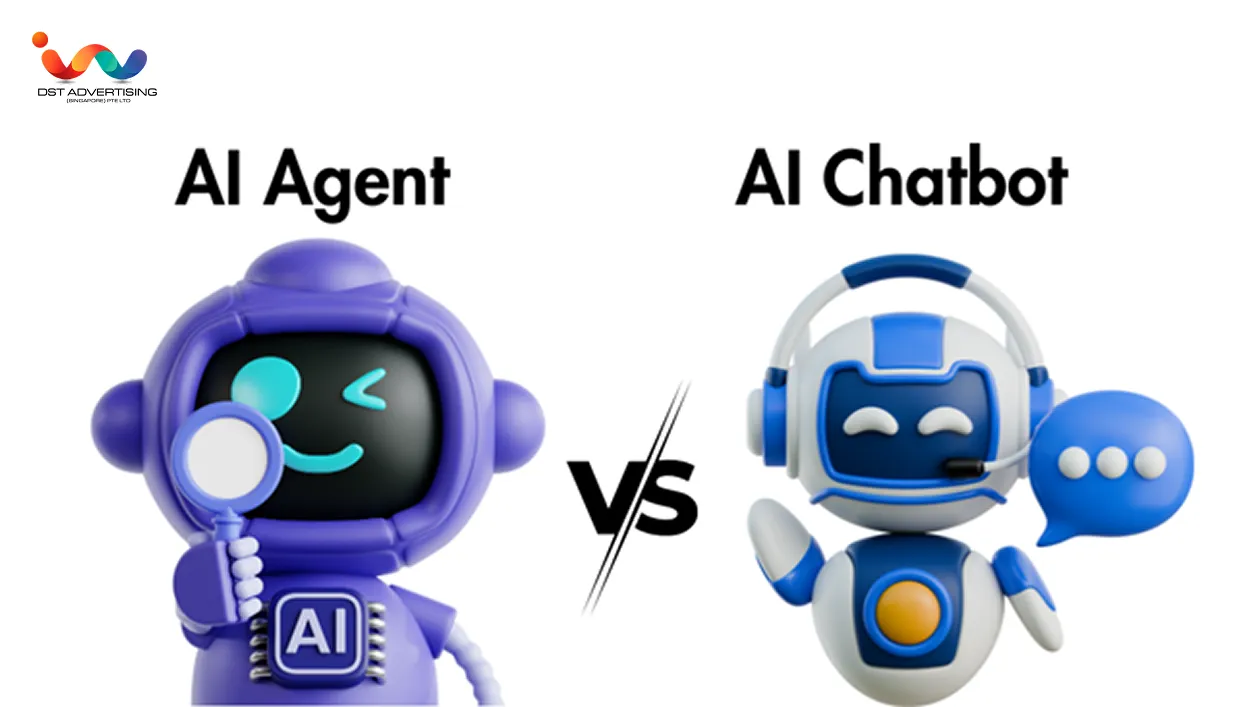
AI Agent vs AI Chatbot: What Is the Difference and Which Does Your Business Need?

Introduction

Artificial intelligence is changing how businesses communicate with customers and automate everyday operations. Two terms that are frequently used in this conversation are AI chatbot and AI agent. Although they may appear similar, they are not exactly the same.

An AI chatbot is primarily designed to communicate with users, answer questions, provide information, and guide people through conversations. An AI agent can go further by working toward a defined goal, planning steps, using connected tools, and taking actions within approved boundaries. The key distinction is generally autonomy and the ability to execute multi-step tasks.

For businesses, understanding the difference is important. A chatbot may be the right choice for answering customer questions and capturing leads, while an AI agent may be more suitable for automating complex workflows across multiple business systems.

This guide explains the difference between AI agents and AI chatbots, their features, use cases, benefits, and how to choose the right solution for your business.

What Is an AI Chatbot?

An AI chatbot is a software application that uses artificial intelligence and natural language processing (NLP) to communicate with users.


Unlike traditional rule-based chatbots that can only respond to predefined commands, modern AI chatbots can understand natural language, interpret questions, and generate more conversational responses.


For example, a customer might ask:

“What time do you close today?”

An AI chatbot can understand the question and provide the appropriate business hours.


AI chatbots are commonly used for:

  • Customer support
  • Frequently asked questions (FAQs)
  • Product recommendations
  • Lead generation
  • Appointment inquiries
  • Order tracking
  • Website assistance
  • Basic troubleshooting
  • Customer service automation

The primary purpose of an AI chatbot is conversation and information delivery.

What Is an AI Agent?

An AI agent is a more advanced AI system that can take action to accomplish a specific goal.


Instead of simply answering a question, an AI agent can determine what needs to happen next, use connected tools or applications, and complete a workflow.


For example, imagine a customer says:

“I want to book an appointment for next Tuesday afternoon.”

A basic chatbot might explain how the customer can schedule an appointment.


An AI agent could potentially:

  1. Understand the customer’s request.
  2. Check the appointment system.
  3. Identify available times.
  4. Present the available options.
  5. Book the selected appointment.
  6. Update the CRM.
  7. Send a confirmation message.

This makes AI agents particularly useful for business process automation and task completion.

AI Agent vs AI Chatbot: Key Difference

The simplest way to understand the difference is this:


An AI chatbot talks. An AI agent can talk and act.

An AI chatbot is generally focused on responding to user requests, while an AI agent can take a goal and perform multiple actions to achieve it.

Feature

AI Chatbot

AI Agent

Conversational communication

Yes

Yes

Answers questions

Yes

Yes

Understands natural language

Yes

Yes

Performs tasks

Limited

Yes

Uses external tools

Sometimes

Commonly

Makes decisions

Limited

Yes

Executes multi-step workflows

Limited

Yes

CRM integration

Possible

Common

Workflow automation

Basic

Advanced

Human intervention

Often required

Can be significantly reduced


The distinction isn’t always absolute. Modern AI platforms can combine chatbot and agent capabilities, creating conversational systems that can both understand users and take actions.

How Do AI Chatbots Work?

An AI chatbot typically follows a conversational process.


First, the user sends a question or request. The chatbot processes the input using natural language understanding and determines the user’s intent.

It then generates or retrieves an appropriate response.


Modern AI chatbots may use technologies such as:


  • Natural language processing
  • Large language models (LLMs)
  • Machine learning
  • Retrieval-augmented generation (RAG)
  • Knowledge bases
  • Conversational memory
  • APIs

For example, an e-commerce chatbot might answer:

Customer: “Do you have black running shoes in size 10?”


The chatbot could search its product information and respond with relevant products.

However, if the customer wants to actually place an order, the chatbot may need additional integrations or agent capabilities to complete the transaction.

How Do AI Agents Work?

AI agents operate around a goal rather than simply a conversation.


An AI agent typically receives an objective, analyzes the available information, determines what actions are required, and uses connected tools to complete the task.


A simplified AI agent workflow looks like this:

User request → Understand goal → Plan → Use tools → Take action → Check result → Respond


For example, an AI sales agent could receive a request to qualify a new lead.

It might:


  • Collect information from the prospect
  • Analyze the lead
  • Check the CRM
  • Determine whether the prospect meets qualification criteria
  • Update the CRM
  • Schedule a sales call
  • Notify the sales representative

This ability to interact with external systems is one of the major differences between an AI agent and a traditional AI chatbot.

AI Chatbot vs AI Agent: Which Is Better?

There isn’t a universal winner.


The right solution depends on what you want AI to accomplish.


If your primary goal is to answer customer questions and provide instant support, an AI chatbot may be enough.


If you want AI to complete business processes, interact with software, make decisions, and automate repetitive workflows, an AI agent may be a better choice.

Choose an AI Chatbot If You Need:


24/7 customer support

A chatbot can answer common questions outside normal business hours.


FAQ automation

If your support team repeatedly answers the same questions, a chatbot can handle many of those interactions automatically.


Lead generation

A chatbot can collect names, email addresses, phone numbers, and other information from website visitors.


Website assistance

Chatbots can help visitors find products, services, resources, or information.


Simple customer interactions

For straightforward conversations that don’t require complex actions, a chatbot can provide an efficient solution.

Choose an AI Agent If You Need:

Advanced workflow automation

AI agents can perform multiple steps instead of simply providing information.


CRM automation

An AI agent can potentially read and update customer information in your CRM.


Appointment scheduling

Agents can connect with scheduling systems to identify availability and complete bookings.


Sales automation

AI agents can qualify leads, follow up with prospects, and assist sales teams.


Multi-system workflows

If a task requires information from multiple applications, an AI agent can coordinate actions across connected systems.

Real-World Example: AI Chatbot vs AI Agent

Consider a digital marketing agency.

A customer visits the agency’s website and asks:


“What SEO services do you offer?”

An AI chatbot can immediately explain the agency’s SEO services, pricing structure, and process.

Now consider another customer asking:


“Can you book me a consultation next week and send the details to my email?”

A more advanced AI agent could potentially:


  • Check the calendar
  • Find available appointment times
  • Ask the customer to select a time
  • Create the appointment
  • Store the lead information
  • Send an email confirmation

The first interaction primarily requires conversation.

The second requires conversation + decision-making + actions.

That’s where AI agents become particularly valuable.

Benefits of AI Chatbots for Businesses

AI chatbots can provide several advantages.


1. 24/7 Customer Support

Customers don’t always contact businesses during working hours. AI chatbots can provide instant responses at any time.


2. Faster Responses

Instead of waiting for a support representative, customers can receive answers immediately.


3. Reduced Support Workload

Chatbots can handle repetitive questions, allowing human employees to focus on more complex customer issues.


4. Better Customer Experience

Fast and accessible communication can make it easier for customers to find information and interact with a business.


5. Scalable Customer Service

A chatbot can communicate with multiple users simultaneously, which can be useful as a business grows.

Benefits of AI Agents for Businesses

AI agents can provide broader automation capabilities.


1. Automate Repetitive Tasks

Agents can perform repetitive workflows that would otherwise require manual employee involvement.


2. Improve Operational Efficiency

Automating multi-step processes can reduce the time employees spend moving information between different systems.


3. Connect Business Applications

AI agents can use APIs and integrations to work with tools such as CRMs, calendars, databases, help desks, and other business software.


4. Support Sales Teams

AI agents can help qualify leads, manage follow-ups, and assist with customer interactions.


5. Reduce Manual Work

When properly designed and monitored, AI agents can take care of routine processes while employees concentrate on strategic work.

Can an AI Chatbot Become an AI Agent?

Yes.

The line between AI chatbots and AI agents is becoming less defined as AI technology develops.


A chatbot can be enhanced with tools, APIs, databases, business rules, memory, and workflow capabilities. Once it can independently perform tasks toward a defined objective, it begins to function more like an AI agent.


For example:

Basic chatbot:

“Your order is currently being processed.”


Agent-enabled system:

“I checked your order status. It is currently being processed and is expected to ship tomorrow. I’ve also updated your support ticket.”

The second system isn’t simply generating an answer. It is retrieving information and taking action.

Do Small Businesses Need AI Agents?

Not necessarily.

One of the biggest mistakes businesses can make is adopting sophisticated AI technology simply because it is trending.


If your business receives a small number of customer inquiries and most questions are straightforward, an AI chatbot may provide everything you need.

An AI agent becomes more valuable when your business has:


  • Repetitive manual processes
  • Large volumes of customer interactions
  • Multiple software systems
  • Complex workflows
  • Sales or support automation requirements
  • Appointment scheduling needs
  • CRM-related tasks
  • Data processing requirements

Start with the business problem rather than the technology.

How to Choose Between an AI Chatbot and AI Agent

Before investing in an AI solution, ask these questions:


What problem are you trying to solve?

If you simply want to answer customer questions, consider a chatbot.

If you want to automate a business process, consider an AI agent.


Does the AI need to take action?

If the system only needs to provide information, a chatbot may be sufficient.

If it needs to create appointments, update records, send emails, process requests, or interact with other applications, an AI agent may be more appropriate.


How complex is the workflow?

Simple questions usually don’t require advanced agent architecture.

Multi-step workflows are better suited to AI agents.


What systems need to be connected?

Consider whether your AI solution needs access to your CRM, calendar, help desk, inventory system, payment platform, or other business tools.

The more systems involved, the more useful an agent-based approach can become.

AI Agents and AI Chatbots Can Work Together

Businesses don’t necessarily have to choose one or the other.

A powerful customer experience can combine both technologies.


For example, an AI-powered customer service system can use a conversational interface to communicate with customers while an AI agent works behind the scenes to retrieve information and perform tasks.


This creates a system that can:

Understand → Communicate → Decide → Act → Confirm

Instead of simply answering customers, the AI becomes part of the business workflow.

The Future of AI Automation

AI is moving beyond simple question-and-answer systems.

As large language models, AI tools, APIs, and automation platforms continue to improve, businesses are increasingly able to build systems that understand natural language and interact with business software.


The future isn’t necessarily about replacing every chatbot with an AI agent.

Instead, businesses will likely use different levels of AI automation depending on the complexity of each task.


A simple FAQ may only require a chatbot.

A customer service workflow may require an AI agent.

A complex business operation may require multiple AI agents working with human employees and existing software.

Final Thoughts

The difference between an AI agent and an AI chatbot comes down largely to their capabilities.

An AI chatbot is primarily designed to communicate, answer questions, and assist users.


An AI agent goes further by reasoning about goals, using tools, making decisions, and completing tasks.


For businesses that need basic customer support and information delivery, an AI chatbot can be an affordable and effective starting point.


For businesses looking to automate complex workflows and connect AI with their existing systems, an AI agent may offer significantly greater capabilities.


The best approach is to identify your business’s specific needs first and then choose the level of AI automation that solves the problem without unnecessary complexity.

Frequently Asked Questions (FAQs)

Is an AI agent the same as an AI chatbot?

No. An AI chatbot primarily focuses on conversation, while an AI agent can interact with tools and systems to perform tasks and achieve goals.

Not always. Chatbots are often better for simple customer support and FAQs, while AI agents are more suitable for complex workflows and automation.

Yes, some advanced chatbots can perform tasks through integrations. When a conversational system can independently plan and execute multi-step tasks, it may be considered an AI agent or agentic system.

Businesses can use AI agents for customer service, sales qualification, appointment scheduling, CRM updates, data processing, internal operations, and other repetitive workflows.

It depends on the business requirements. A chatbot may be sufficient for FAQs and customer support, while an AI agent can be useful when the business needs advanced workflow automation.

The main advantage is their ability to go beyond generating responses and actually perform actions using connected tools and business systems.

Latest Post

Our Blog Stories

Businesses of every size are transforming the way they connect with customers through AiChat. From instant support to intelligent sales funnels here’s how our clients describe their success.

AI Chatbot

AI Chatbot for E-commerce: How to Automate Orders, FAQs and Product Recommendations

Online shoppers expect fast answers, convenient support, and personalized shopping experiences. However, managing a growing number of customer questions about products, orders, shipping, returns, and availability can place significant pressure on an e-commerce team.

An AI chatbot for e-commerce can help automate many of these interactions. By using artificial intelligence to understand customer questions and provide relevant responses, businesses can offer faster support while reducing repetitive manual work.

From answering frequently asked questions to helping customers track orders and discover suitable products, AI chatbots can support multiple stages of the online shopping journey.

This guide explains how an AI chatbot can automate orders, FAQs, and product recommendations and how e-commerce businesses can use the technology effectively.

AI Solutions Singapore

PSG Grant for AI Solutions in Singapore: A Guide for SMEs

Artificial intelligence is becoming increasingly accessible to small and medium-sized enterprises (SMEs) in Singapore. From AI-powered customer service and marketing tools to automation, analytics, document processing, and sales solutions, businesses can now adopt technologies that were once available mainly to larger organisations.
One important source of support is the Productivity Solutions Grant (PSG). The grant helps eligible Singapore businesses adopt pre-approved IT solutions and equipment that improve productivity and automate business processes. As Singapore expands support for digital and AI-enabled solutions, SMEs may find more opportunities to adopt AI tools with government support.

This guide explains how the PSG works, who may be eligible, how AI solutions fit into the programme, and what SMEs should consider before applying.

Customer Support Automation

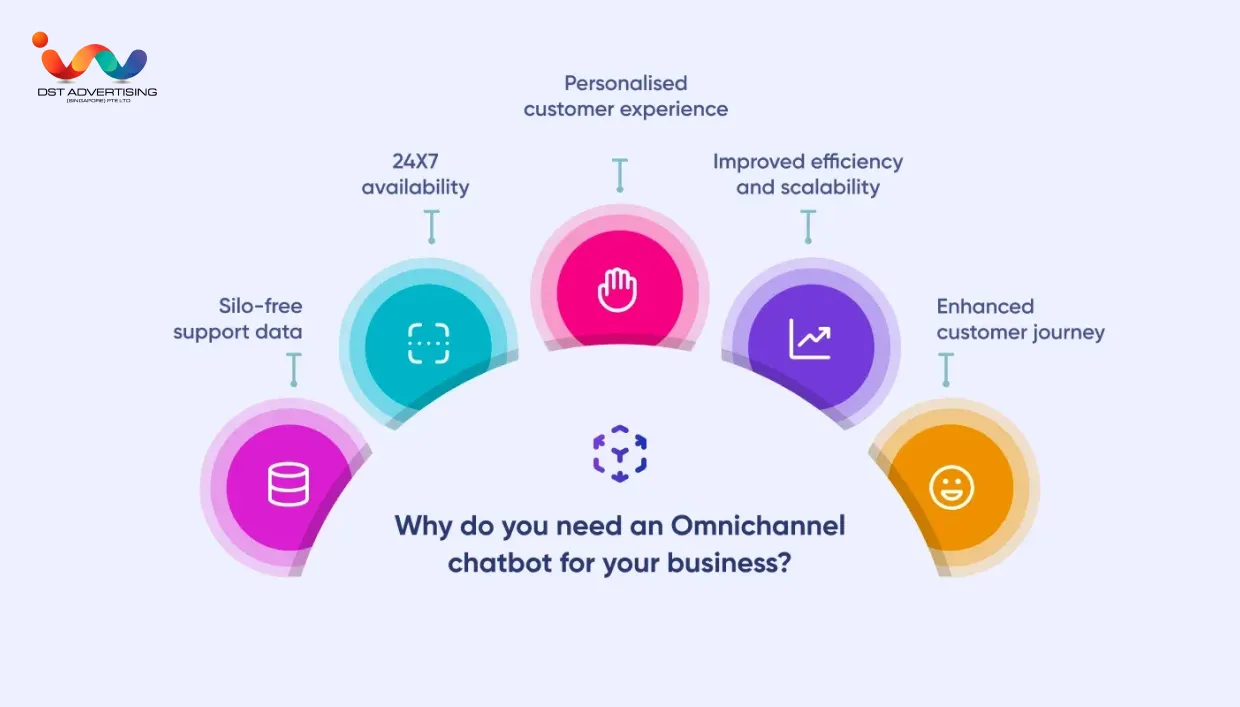
What Is an Omnichannel AI Chatbot? Benefits for Modern Businesses

Modern customers expect quick, convenient, and consistent communication with businesses. Whether they contact a company through a website, Facebook Messenger, WhatsApp, Instagram, or another digital channel, they want fast answers without having to repeat themselves.
This is where an omnichannel AI chatbot can make a major difference.

Unlike a traditional chatbot that operates on only one platform, an omnichannel AI chatbot can provide automated and connected customer support across multiple communication channels. It helps businesses deliver a smoother customer experience, improve response times, reduce support workloads, and stay available around the clock.

In this article, we will explain what an omnichannel AI chatbot is, how it works, and the key benefits it offers modern businesses.

Ready To Transform Your Business Today?

Book your free demo with DST Advertising Singapore.