How Much Does an AI Chatbot Cost in Singapore? Pricing, Features and ROI
Introduction
AI chatbots are becoming an increasingly popular tool for businesses in Singapore. Companies are using them to automate customer support, answer frequently asked questions, qualify leads, recommend products, schedule appointments, and support sales teams.
However, one of the first questions business owners ask is:
How much does an AI chatbot cost in Singapore?
The answer depends on several factors. A simple website chatbot may cost relatively little, while a customised AI chatbot integrated with a CRM, e-commerce platform, WhatsApp, and internal business systems can require a significantly larger investment.
In this guide, we break down the main factors that affect AI chatbot pricing in Singapore, the features businesses should look for, and how to calculate the potential return on investment (ROI).
How Much Does an AI Chatbot Cost in Singapore?
AI chatbot costs in Singapore can vary widely depending on whether you choose a simple subscription-based platform, a customised solution, or an enterprise-level implementation.
As a general guide, businesses may encounter pricing such as:
AI Chatbot Type | Typical Cost Range |
Basic DIY or no-code chatbot | Free to around S$50/month |
SME AI chatbot platform | Around S$50–S$300/month |
Omnichannel AI chatbot | Around S$100–S$1,000+/month |
Custom AI chatbot | Approximately S$5,000–S$50,000+ upfront |
Enterprise AI chatbot | S$30,000–S$100,000+ depending on complexity |
These figures should be treated as general market estimates rather than fixed industry rates. Actual pricing depends heavily on the chatbot provider, integrations, AI model usage, conversation volume, custom development, security requirements, and ongoing maintenance. Recent Singapore provider guides show a similar wide spread between SaaS solutions and bespoke implementations.
1. Basic AI Chatbot: Free to S$100 per Month
A basic AI chatbot is usually the most affordable option for small businesses that want to automate common customer enquiries.
These solutions may include:
- Website chat widget
- FAQ automation
- Basic AI responses
- Knowledge base integration
- Limited monthly conversations
- Basic analytics
- Simple lead capture
This option can be suitable for businesses that primarily want to answer repetitive questions such as:
- What are your opening hours?
- What services do you provide?
- How can I contact your team?
- Where are you located?
- How does your pricing work?
A subscription-based chatbot can be a practical starting point because it usually requires little or no custom software development.
2. SME AI Chatbot: S$100 to S$500 per Month
Growing businesses may require more advanced capabilities than a simple FAQ chatbot.
A mid-range AI chatbot may include features such as:
- Larger knowledge bases
- Lead qualification
- Appointment booking
- CRM integration
- Conversation analytics
- Human agent handoff
- Multiple users
- Higher conversation limits
- Basic automation workflows
The final cost may increase depending on the number of customer conversations and integrations required.
For example, a chatbot connected only to a website is generally less complex than one connected to a CRM, booking system, e-commerce platform, and multiple messaging channels.
3. Omnichannel AI Chatbot: S$100 to S$1,000+ per Month
An omnichannel AI chatbot allows businesses to manage customer conversations across multiple communication channels.
Depending on the platform, this may include:
- Website live chat
- WhatsApp
- Facebook Messenger
- Instagram
- Telegram
- Mobile applications
- Other messaging platforms
The cost can increase as businesses add more channels and integrations.
For example, an omnichannel solution may require additional expenses for:
- Messaging platform access
- Conversation volume
- API usage
- CRM integration
- Automation workflows
- Additional support agents
- Advanced analytics
Businesses should therefore look beyond the advertised monthly subscription price and ask for a complete breakdown of potential recurring costs.
4. Custom AI Chatbot: S$5,000 to S$50,000+
A custom AI chatbot is designed specifically around a company’s business processes.
Unlike a standard chatbot platform, a custom solution may be built to connect with internal systems and automate more complex workflows.
For example, a customised chatbot could integrate with:
- CRM software
- ERP systems
- E-commerce platforms
- Inventory systems
- Appointment booking tools
- Customer databases
- Internal knowledge bases
- Payment or order management systems
A recent Singapore market guide places simple custom builds around the lower five-figure range, while more complex and enterprise-grade implementations can rise significantly higher. (PalaChat)
What Affects Custom AI Chatbot Costs?
The final development cost usually depends on:
- Number of communication channels
- Number and complexity of integrations
- Custom conversation workflows
- Knowledge base size
- AI model and API usage
- Security requirements
- User authentication
- Multilingual support
- Analytics dashboards
- Ongoing maintenance
A simple chatbot that answers FAQs will cost considerably less than a chatbot capable of checking customer orders, updating CRM records, qualifying leads, and handling conversations across several channels.
5. Enterprise AI Chatbot: S$30,000 to S$100,000+
Large organisations may require enterprise-level features that increase both development and ongoing costs.
These may include:
- Advanced system integrations
- Private or controlled data environments
- Role-based access
- Advanced security controls
- High conversation volumes
- Custom reporting
- Multiple languages
- Complex workflow automation
- Dedicated infrastructure
- Service-level agreements
- Continuous monitoring and maintenance
For enterprise businesses, the question is often not simply, “How much does the chatbot cost?”
A more important question is:
“How much business value can the chatbot create?”
Key Features That Affect AI Chatbot Pricing
AI Model and Usage Costs
Many AI chatbots rely on large language models through APIs. Costs may depend on the amount of text processed and generated.
For example, API providers charge based on usage, meaning higher conversation volumes and more complex AI interactions can increase operational costs.
This is why businesses should ask whether a chatbot provider includes AI usage in its monthly price or charges separately for:
- Messages
- Conversations
- AI credits
- Tokens
- API calls
Knowledge Base Integration
A chatbot that only handles a few FAQs may require minimal setup.
However, businesses with large amounts of information may need the chatbot to access:
- Website pages
- PDFs
- Product catalogues
- Internal documents
- FAQs
- Policies
- Training materials
The more complex the knowledge base, the more setup, testing, and maintenance may be required.
CRM and Business System Integration
Integrating a chatbot with systems such as a CRM or ERP can increase costs.
For example, the chatbot may need to:
- Create new leads
- Retrieve customer information
- Update records
- Check order status
- Schedule appointments
- Trigger follow-up workflows
Custom API development may be required for more complex integrations.
Multichannel Support
Adding more communication channels can increase the total cost.
A website-only chatbot is usually simpler to implement than a solution operating across:
- Website
- WhatsApp
- Facebook Messenger
- Instagram
- Mobile apps
Businesses should focus on the channels their customers actually use rather than paying for unnecessary integrations.
Multilingual Support
Singapore businesses may need chatbot support for multiple languages depending on their target audience.
Potential languages may include:
- English
- Mandarin
- Malay
- Tamil
- Other regional languages
Multilingual requirements can increase implementation, testing, and maintenance costs.
How to Calculate AI Chatbot ROI
The return on investment from an AI chatbot should be measured using business outcomes rather than simply the number of conversations handled.
A simple ROI calculation is:
ROI = (Financial Benefit − Total Investment) ÷ Total Investment × 100
For example:
- Total chatbot cost: S$12,000 per year
- Estimated annual savings and additional value: S$30,000
The calculation would be:
ROI = (S$30,000 − S$12,000) ÷ S$12,000 × 100
ROI = 150%
However, the financial benefit should be based on realistic and measurable results.
Where Can an AI Chatbot Generate ROI?
1. Reduced Customer Support Workload
If a chatbot handles repetitive questions, support employees may spend less time answering the same enquiries.
For example, calculate:
Hours saved × employee hourly cost = potential labour savings
Suppose a support team saves 30 hours per month and the estimated cost of that time is S$25 per hour:
30 × S$25 = S$750 per month
That represents approximately S$9,000 per year in potentially recoverable staff capacity.
The actual financial benefit depends on whether those saved hours result in reduced costs or allow employees to perform other valuable work.
2. More Leads Captured
An AI chatbot can engage website visitors outside business hours and collect lead information.
For example:
- 100 additional qualified leads per year
- 10% become customers
- Average customer value: S$2,000
Potential additional revenue:
10 customers × S$2,000 = S$20,000
This does not mean the chatbot automatically creates S$20,000 in profit, but it provides a framework for measuring whether automation contributes to additional business opportunities.
3. Faster Customer Response Times
Slow responses can result in lost enquiries and poor customer experiences.
An AI chatbot can provide immediate answers to common questions, even outside normal business hours.
Businesses can monitor:
- Average response time
- Number of enquiries handled
- Resolution rate
- Escalation rate
- Customer satisfaction
- Conversion rate
4. Increased Sales Through Product Recommendations
For e-commerce businesses, an AI chatbot can help customers discover and compare products.
It may ask questions about:
- Budget
- Product preferences
- Size
- Intended use
- Required features
The chatbot can then recommend relevant products from the available catalogue.
Businesses can measure the impact through:
- Conversion rates
- Average order value
- Revenue from chatbot-assisted sessions
- Product recommendation engagement
Singapore SMEs and AI Adoption
AI adoption among Singapore SMEs has grown rapidly. According to IMDA’s Singapore Digital Economy reporting, SME AI adoption increased from 4.2% in 2023 to 14.5% in 2024. IMDA also reported that SMEs using AI-enabled solutions under the Productivity Solutions Grant achieved average cost savings of 52% in 2024, although individual results will vary significantly depending on the solution and implementation.
Singapore has also introduced further initiatives under its National AI Impact Programme to support enterprise AI adoption.
This makes it important for SMEs to evaluate AI chatbots based on measurable business needs rather than adopting AI simply because it is a growing technology trend.
What Should Singapore Businesses Look for in an AI Chatbot?
Before choosing an AI chatbot, consider the following features:
AI-Powered Natural Language Understanding
The chatbot should understand different ways customers ask the same question.
Knowledge Base Integration
It should be able to access accurate and approved business information.
Human Agent Handoff
Customers should be transferred to a human agent when the issue is too complex for automation.
CRM Integration
The chatbot should integrate with existing customer and lead management systems when necessary.
Multi-Channel Support
Choose channels based on where your customers actually communicate.
Analytics and Reporting
Look for insights into:
- Conversation volume
- Common questions
- Resolution rates
- Lead generation
- Customer engagement
- Escalation rates
Security and Data Controls
Businesses handling customer information should consider:
- Access controls
- Data storage
- Authentication
- Privacy requirements
- Vendor security practices
How to Choose the Right AI Chatbot Budget
A useful approach is to start with the business problem.
Choose a Basic Chatbot If:
- You mainly want to answer FAQs.
- You have a limited budget.
- You only need website chat.
- You want to test customer demand for automation.
Choose a Mid-Range AI Chatbot If:
- You receive a high number of customer enquiries.
- You need lead generation.
- You want appointment booking.
- You need CRM integration.
- You want better analytics.
Choose a Custom AI Chatbot If:
- Your workflows are unique.
- You need integration with internal systems.
- You want to automate complex processes.
- Standard chatbot platforms cannot meet your requirements.
Choose an Enterprise Solution If:
- You manage high conversation volumes.
- You require advanced security.
- You operate across multiple departments.
- You need complex system integrations.
- You require detailed reporting and governance.
Hidden Costs to Consider
Before signing up for an AI chatbot, ask about potential additional costs.
These may include:
- Setup and onboarding fees
- Custom development
- AI API usage
- Additional conversations
- CRM integration
- WhatsApp or messaging costs
- Knowledge base setup
- Maintenance
- Security upgrades
- Staff training
- Custom analytics
A chatbot advertised at S$100 per month may cost significantly more once integrations and usage fees are included.
Always request a clear breakdown of:
Setup Cost + Monthly Subscription + Usage Fees + Integration Costs + Maintenance
Is an AI Chatbot Worth the Investment?
An AI chatbot can be worth the investment when it solves a clear and measurable business problem.
It may be particularly useful if your business:
- Receives a high volume of repetitive enquiries
- Has slow customer response times
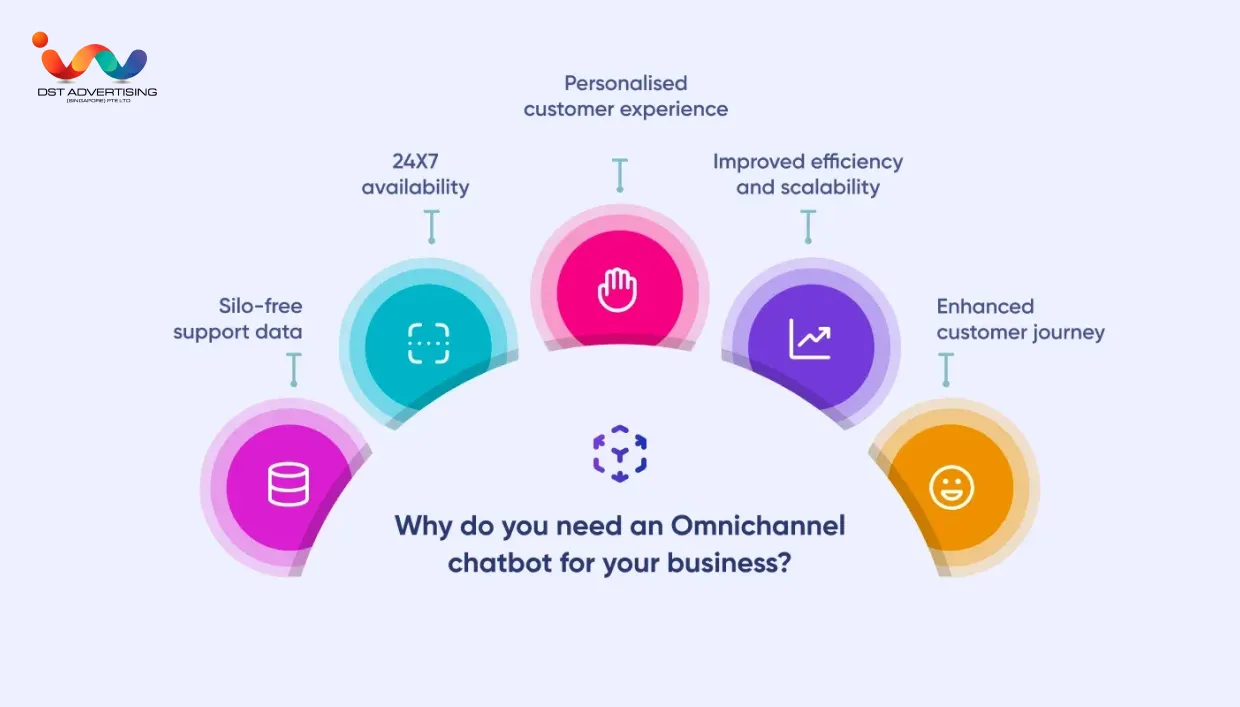
- Wants to provide 24/7 assistance
- Needs better lead capture
- Manages enquiries across multiple channels
- Wants to automate routine customer service tasks
However, businesses with very low enquiry volumes or highly specialised customer interactions may not achieve a strong return from an expensive custom chatbot.
The best approach is often to begin with a focused use case, measure the results, and expand automation when the business case is proven.
Final Thoughts
The cost of an AI chatbot in Singapore can range from a relatively affordable monthly subscription to a significant custom technology investment.
A basic chatbot may cost under S$100 per month, while more advanced platforms can range from hundreds to thousands of dollars per month. Custom and enterprise AI chatbot projects can require five-figure or higher upfront investments, depending on the complexity of the integrations and workflows.
The right choice depends on your business goals.
Rather than choosing the most advanced or expensive AI chatbot, focus on the areas where automation can deliver measurable value. This could include reducing repetitive support work, capturing more leads, improving response times, or helping customers find the right products and services.
When businesses measure both the total cost of ownership and the actual business outcomes, an AI chatbot can become a practical investment in productivity, customer experience, and long-term growth.